Hawamish 1
فتاة مصرFatat Misr
Ya’qub Sarruf · a novel · Cairo, 1905
In preparation. No date yet.
The novel
Ya’qub Sarruf1 wrote Fatat Misr for al-Muqtataf, where it ran in parts before it came out as a book, and the book sold out within its first year. It opens in London, in the house of Sir Edward Brown, owner of the London News, whose son Henry and daughter Dora are about to set out on a year’s journey east. By the third chapter they are in Cairo.
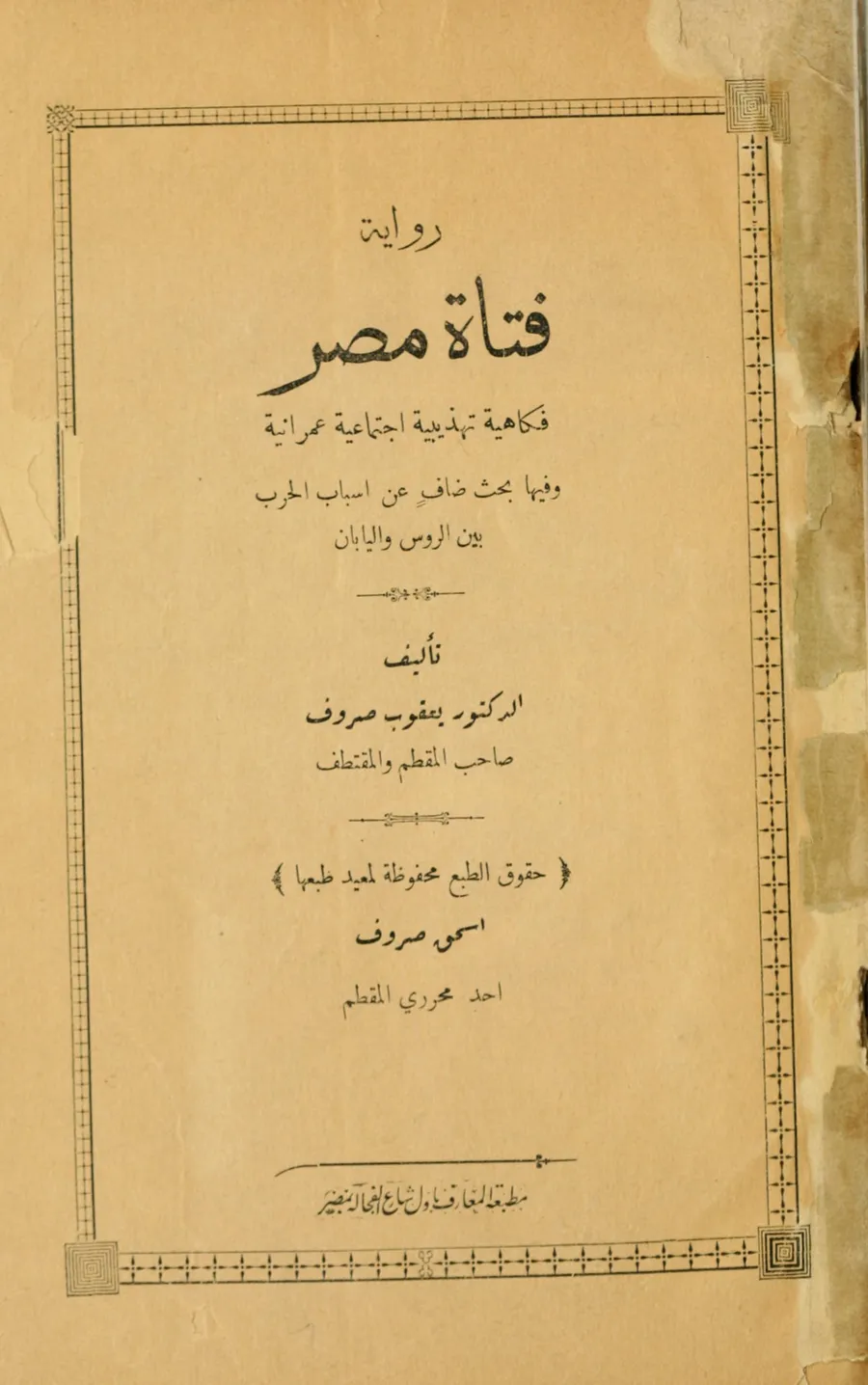
The title page calls it “entertaining, improving, social and civilisational”,2 and promises “a full inquiry into the causes of the war between the Russians and the Japanese”.
The 1905 printing
The edition follows the reissue that his brother Ishaq Sarruf3 arranged in 1905 at Matba’at al-Ma’arif in Cairo: five pages of front matter, numbered in letters, and 187 pages of text.4 Ishaq’s preface quotes at length a review by Jabr Dumit, who taught Arabic at the Syrian Protestant College in Beirut and had read the novel in parts as it came out.
This edition
The text is transcribed line for line from the scan of the Toronto copy, exactly as printed. The reading text is made from that transcription by rules that the introduction states: the author’s words stay as they are, the printer’s spellings of hamza and final ya are brought into line, and light punctuation is added.5 Notes in the margin explain the people, places and events that a reader in 1905 knew, from the Boer War to the war between Russia and Japan.
The introduction covers Sarruf and al-Muqtataf, the novel’s success, and how it was read, including by critics who saw it as taking the side of the British occupation.
The first page
The novel’s first paragraph as the 1905 printing has it, set in the house style. The notes for the edition are still to be written; the one beside it shows their form.
نموذج
في حيٍّ من احياءِ لندن الجديدة حيث يقلُّ الازدحام وتتَّسع الرحاب المتروكة من غير بناء بمساعي ارل ميث١ لتجديد الهواءِ وتطهير الدماءِ وانعاش الابدان بيت كبير بل قصر فخيم مبنيٌّ على نسق القلاع القديمة تحيط بهِ حديقة غنَّاء واسعة الارجاءِ ملتفة الاشجار هبَّت رياح الخريف على اشجارها ورياحينها فتورَّدت واغنتها عن الازهار حتى خُدِع النحل بها وصار يقع عليها ليتعلَّل بشيءٍ من الاري يجدهُ فيها